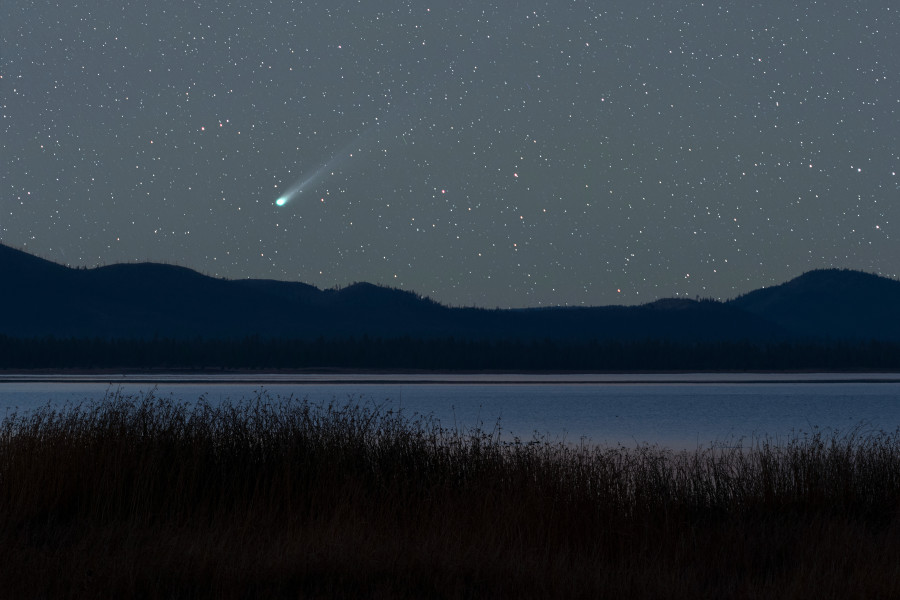
"Comet C/2025 A6 Lemmon Over Eagle Lake "
By: Micheal Lee (Janesville, CA)
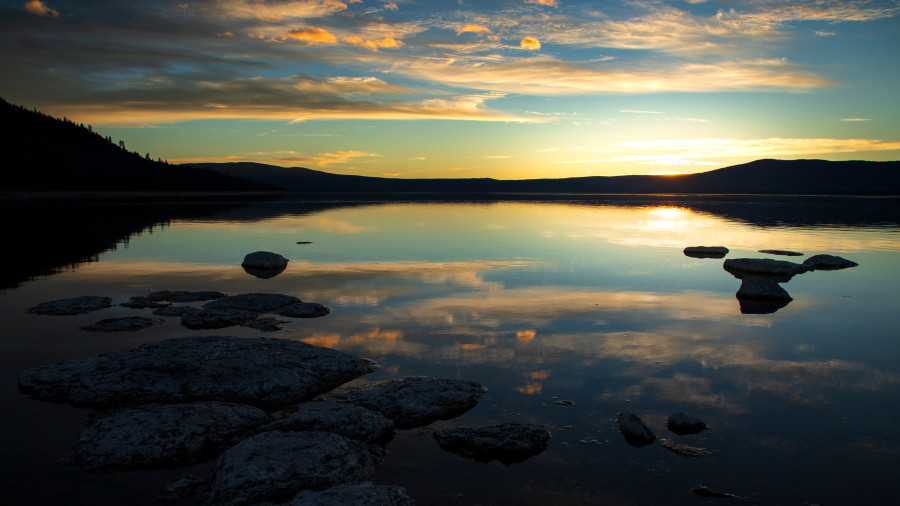
On October 18, 2025, I took my first shot at photographing Comet C/2025 A6 (Lemmon). I went to the south shore of Eagle Lake, near the long-defunct Aspen Grove boat ramp. At this location I knew there wouldn't be too much high terrain obscuring the northwestern sky. At the very beginning of "astro darkness," the comet was only about 16 degrees above the horizon and setting from there. I set up at dusk and captured some foreground frames using my compass as a guide for the proper direction (in this case 305 degrees). Once it was dark enough, I started taking test shots trying to find the comet. Unlike 2024’s Atlas comet, Lemmon wasn’t naked-eye visible, so it took some effort to find it in the camera. Once I located it, I shot a stack of frames. I used my lovely bride's 100mm macro lens, which is generally for shooting things a few million miles closer, but it has a big aperture to let in lots of light and a bit of focal length for magnification. By using a motorized tracking mount for my camera, I was able to shoot full minute-long exposures without the stars and comet “trailing” due to Earth’s rotation. I used my Canon R7, which is a "crop sensor" camera, so the field of view seen here is even a bit narrower—what you see here is about what you'd see if you stood in this spot with a 3X magnification lens. Discovered by the Mount Lemmon Survey in early 2025, Comet C/2025 A6 (Lemmon) made its closest approach to Earth on October 21, 2025. The comet’s distinct green glow comes from diatomic carbon (C₂) gas fluorescing under ultraviolet sunlight, a hallmark of comets as their volatile ices vaporize near the Sun. Its dust tail reflects sunlight, while the faint, narrow ion tail—often bluish—forms as charged gas molecules are swept away by the solar wind and magnetic fields. Together they reveal the dynamic chemistry and physics of a body transitioning from deep-space slumber to brief brilliance in the inner solar system.
Camera Information: Canon R7 - Canon EF100mm F2.8
Image Location: Susanville California
Category: Scenic Wild Landscapes
Other entries from Micheal Lee